WooCommerce vs Shopify is the most common platform decision for UK businesses building an online store in 2026. Both are capable, both are widely used, and both have genuine strengths. The right answer depends on your business model, technical setup, growth plans, and how much you value control versus convenience.
This guide gives you an honest comparison — costs, SEO, customisation, scalability, and the scenarios where each platform wins — so you can make an informed decision rather than one based on marketing claims.
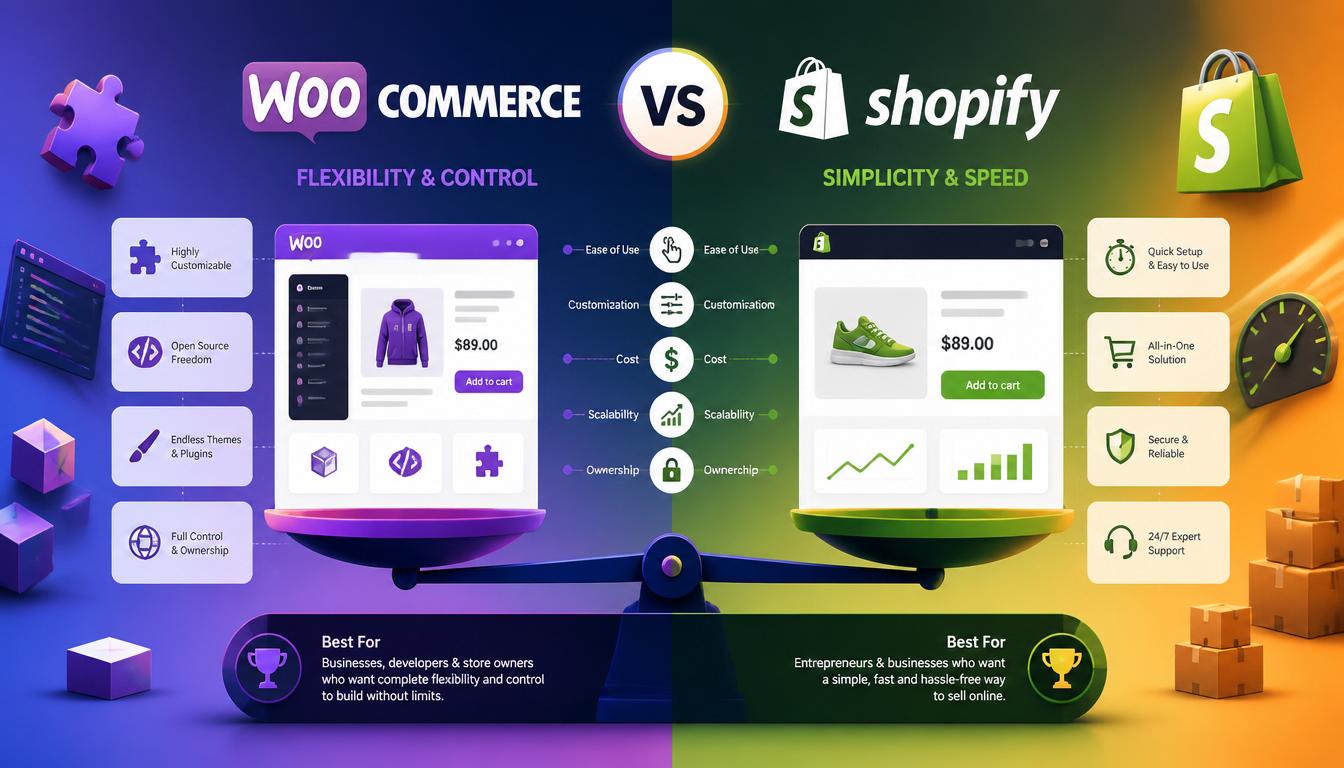
WooCommerce vs Shopify comparison 2026
Quick Comparison: At a Glance
| Feature | WooCommerce | Shopify |
|---|---|---|
| Platform cost | Free (open-source) | £25–£344/month (billed monthly) |
| Third-party transaction fees | None (gateway fees only) | 0.6–2% unless using Shopify Payments |
| Hosting | Your choice (£10–£80/month) | Included |
| SEO control | Complete | Limited |
| Customisation | Unlimited | Theme-dependent |
| Technical skill required | Moderate to high | Low |
| Best for | Long-term growth, SEO, control | Quick launch, simplicity |
The Core Difference
The fundamental distinction between WooCommerce and Shopify isn’t features — it’s philosophy.
WooCommerce is a free, open-source plugin that runs on WordPress. You own everything: your hosting, your data, your code, your URLs. You’re responsible for security, updates, and performance. In return, you have unlimited flexibility and no platform lock-in.
Shopify is a hosted SaaS platform. Shopify manages the infrastructure, security, and software — you rent space on their platform. Setup is faster, and maintenance overhead is lower, but you operate within Shopify’s rules, pricing structure, and technical constraints.
Everything else — pricing, SEO capability, customisation depth, scalability — flows from this difference.
Cost Comparison: WooCommerce vs Shopify
This is where WooCommerce’s advantage is most concrete.
| Cost Element | WooCommerce | Shopify |
|---|---|---|
| Platform fee | Free | £25–£344+/month (Basic to Advanced, billed monthly) |
| Third-party transaction fees | None (gateway fees only) | 0.6–2% unless using Shopify Payments |
| Hosting | £10–£80/month (your choice) | Included |
| Domain | £10–£20/year | £10–£20/year (or free subdomain) |
| SSL | Usually free with hosting | Included |
| Premium theme | £0–£100 one-off | £140–£350+ one-off |
| Essential plugins/apps | £100–£300/year | £200–£600+/year |
| Typical annual total (small store) | £300–£700/year | £600–£1,200+/year |
The transaction fee difference is significant at scale. If all £200,000 in annual sales is processed through a third-party payment provider on Shopify Basic, the 2% third-party transaction fee would add £4,000 a year, on top of the subscription. WooCommerce has no platform transaction fee, but payment gateway fees still apply. For example, Stripe currently charges 1.5% + 20p for standard UK cards and 2.5% + 20p for EEA cards; other card types and currency conversion may have different rates.
Pro Tip: For a UK store doing £100,000/year using a third-party gateway such as Stripe: Shopify costs ~£2,500/year (£300 Basic plan + £2,000 in 2% platform transaction fees + £200 apps). WooCommerce costs ~£350/year (£180 managed hosting + £0 platform fees + £170 plugins). That’s roughly £2,150 saved annually — money you can reinvest in marketing or product development.
SEO: WooCommerce vs Shopify
WooCommerce wins on SEO flexibility. This matters if organic search is part of your customer acquisition strategy — and for most UK e-commerce businesses, it should be.
| SEO Factor | WooCommerce | Shopify |
|---|---|---|
| URL structure | Fully customisable | Partial — /products/ and /collections/ paths are locked |
| Meta titles and descriptions | Full control via SEO plugin | Editable but limited templating |
| Product schema | Full control, auto-generated by Rank Math | Basic schema included, customisation limited |
| Blog/content marketing | Full WordPress CMS | Basic blog, limited CMS functionality |
| Page speed | Dependent on hosting and configuration | Good baseline, less control over optimisation |
| Canonical URLs | Full control | Automatically managed, limited override |
| Faceted navigation handling | Manual but fully controllable | Automated, less transparent |
Shopify’s SEO has improved substantially since 2022 and is no longer weak in absolute terms. For most stores, both platforms can rank well. The WooCommerce advantage is most pronounced for stores with complex content strategies, large catalogues requiring careful crawl budget management, or businesses where topical authority through blogging is a core tactic.
For a deeper look at WooCommerce SEO specifically, see our complete WooCommerce SEO guide.
Customisation and Design
Both platforms support extensive customisation — the question is how and at what cost.
WooCommerce works with any WordPress theme and any page builder (Elementor, Bricks, Divi, or custom). There are no design constraints imposed by the platform. A developer can build anything — custom checkout flows, bespoke product configurators, entirely unique layouts — without fighting the platform. The WordPress ecosystem has 50,000+ plugins covering almost every conceivable requirement.
Shopify uses its own Liquid templating language, and customisation beyond theme settings requires Liquid knowledge or a developer familiar with Shopify’s specific environment. Shopify’s app ecosystem is excellent, but apps tend to be more expensive than WordPress equivalents, and complex customisations can conflict with Shopify’s checkout restrictions (the checkout page is locked on the Basic, Grow and Advanced plans — only Plus subscribers can customise it).
For bespoke, brand-specific design — the kind of store that looks nothing like a template — WooCommerce with a skilled developer delivers more for less. For a clean, functional store launched quickly with minimal custom work, Shopify’s themes are polished and require less configuration.
Ease of Use
Shopify wins here, clearly. The platform is designed for non-technical users — setup wizard, hosted infrastructure, automatic updates, and a single dashboard for everything. You can have a functioning store live in a day without touching code.
WooCommerce requires more setup: choosing and configuring hosting, installing WordPress, installing and configuring WooCommerce and supporting plugins, managing updates, and handling security. For someone without technical experience or a developer relationship, this overhead is real.
That said, a well-built WooCommerce store managed by an experienced WordPress developer is not meaningfully harder to use day-to-day than Shopify — adding products, managing orders, running promotions, and writing blog posts are all straightforward in both platforms.
Scalability
Both platforms scale — the question is how.
Shopify’s infrastructure scales automatically. High-traffic events (Black Friday, viral products) are handled by Shopify’s servers without any action from you. You pay more as you grow (higher plan tiers), but you don’t manage the infrastructure.
WooCommerce scales through your hosting stack. A properly configured WooCommerce store on managed hosting (Cloudways, Kinsta) with caching (WP Rocket) and a CDN (Cloudflare) handles high traffic events very well. The ceiling is high — WooCommerce runs stores turning over millions of pounds annually. But scaling requires active infrastructure management, either by you or a developer.
For very high volume stores (thousands of orders per day), Shopify Plus removes most of the customisation limitations and provides dedicated infrastructure — from £1,800/month. At that level, a custom WooCommerce build on dedicated infrastructure is also viable and often cheaper.
Payments
Shopify Payments is available in the UK and does not incur Shopify’s additional third-party transaction fee on eligible payments. However, card-processing fees still apply. If you use an external payment provider, Shopify adds a third-party transaction fee of 2% on Basic, 1% on Grow and 0.6% on Advanced; the provider may also charge its own processing fees.
WooCommerce has no platform transaction fee and lets you choose from gateways such as Stripe, PayPal, Klarna, Opayo, Worldpay and GoCardless. You pay the gateway’s own processing fees; for example, Stripe currently charges 1.5% + 20p for standard UK cards and 2.5% + 20p for EEA cards. Other card types and currency conversion may have different rates.
Migrating Between Platforms
Migration is worth considering before you commit — switching platforms later is painful and expensive.
Migrating from Shopify to WooCommerce is doable but involves exporting products, orders, and customers and importing to WooCommerce, rebuilding theme/design, reconfiguring apps/plugins, and setting up 301 redirects to preserve SEO equity. Budget for developer time and expect some SEO disruption during transition.
Migrating from WooCommerce to Shopify follows a similar process in reverse, with the added complexity that Shopify’s URL structure differs from WooCommerce’s — which means every product URL changes and requires redirects.
Pro Tip: The cost of migration is one reason to make the right platform choice at the start rather than switching after you’ve built a catalogue and established organic rankings. If you’re unsure, start with WooCommerce — it’s easier to simplify later than to migrate away from platform limitations.
For more on why WooCommerce is the right long-term choice, see our article on why use WooCommerce.
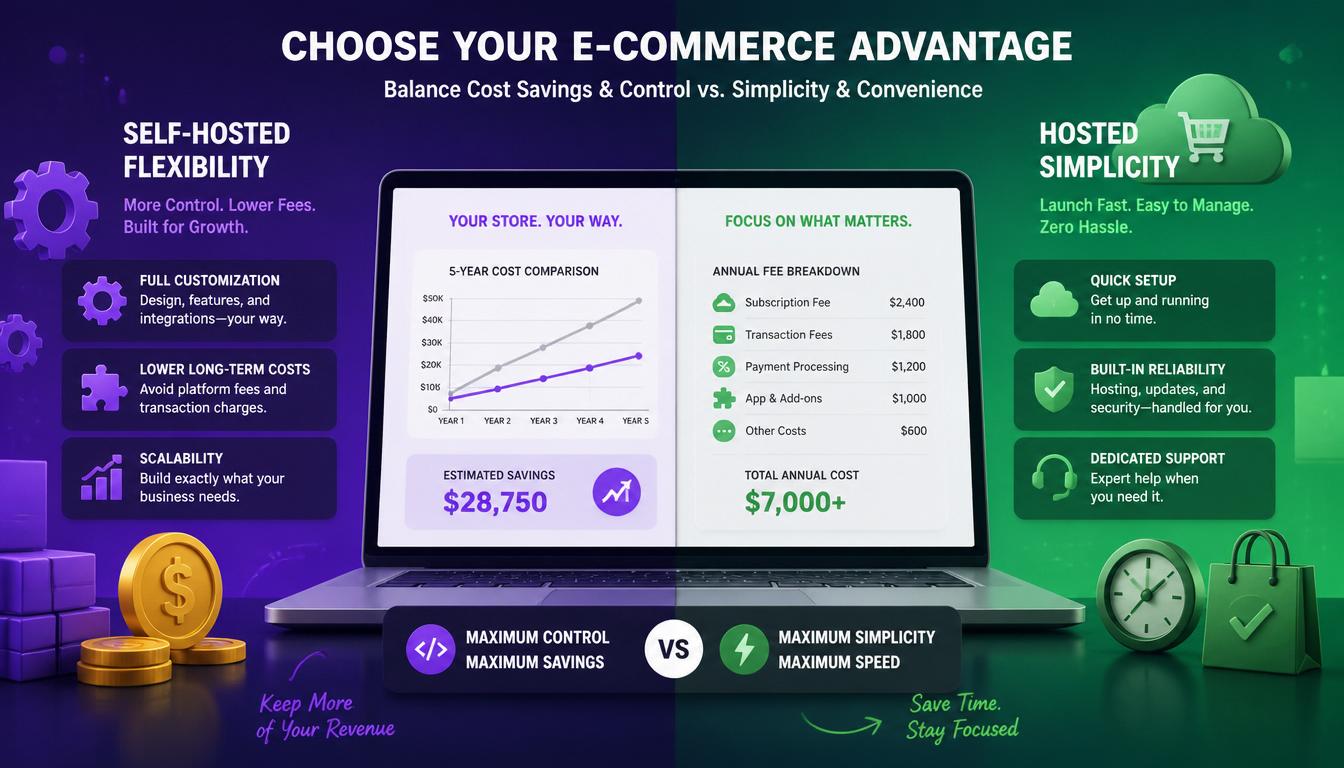
WooCommerce store setup and management
WooCommerce vs Shopify: Which Should You Choose?
| Choose WooCommerce if… | Choose Shopify if… |
|---|---|
| You’re already on WordPress | You want a fully managed, hands-off platform |
| SEO and organic traffic are central to your strategy | You need to launch quickly with minimal technical setup |
| You want zero platform transaction fees | You’re happy using Shopify Payments exclusively |
| You need full design and checkout customisation | You want polished templates with minimal customisation |
| You have (or will hire) developer support | You have no technical resource and won’t hire any |
| You’re scaling past the point where Shopify fees matter | You’re a small store where convenience outweighs cost |
| You want to own your data and avoid platform lock-in | You prioritise simplicity over control |
For most UK businesses working with a web developer — particularly those where content marketing, SEO, and long-term cost efficiency matter — WooCommerce delivers more value. For a solo founder who needs a store live this week with no technical help and no plans to invest in SEO, Shopify’s lower barrier to entry is a genuine advantage.
Pro Tip: The “WooCommerce is harder” argument is largely about initial setup, not ongoing use. A properly built WooCommerce store — good hosting, well-configured plugins, a developer who knows the stack — is not meaningfully more work to manage day-to-day than Shopify. The complexity is front-loaded into the build, not spread across every week of operation.
Ready to get started? Follow our step-by-step WooCommerce setup guide to launch your store correctly from day one.
Frequently Asked Questions
Is WooCommerce free compared to Shopify?
WooCommerce itself is free — no platform subscription. You pay for hosting (£10–£80/month depending on quality), a domain, and any premium plugins you need. Total annual costs for a small WooCommerce store typically run £300–£700, compared to £600–£1,200+ for an equivalent Shopify setup including apps. The gap widens as revenue grows, because Shopify charges transaction fees unless you use Shopify Payments.
Is WooCommerce better than Shopify for SEO?
WooCommerce offers more SEO flexibility — full URL control, complete schema customisation, deep integration with professional SEO plugins, and the full WordPress content management system for blogging and content marketing. Shopify has improved significantly and can rank well, but URL structure limitations and less granular schema control put it behind WooCommerce for stores where organic search is a primary channel.
Can I switch from Shopify to WooCommerce?
Yes, but it’s a proper migration project — products, customers, orders, redirects, theme rebuild, and plugin configuration all need to be handled. Budget for developer time and expect a period of SEO fluctuation while redirects settle. It’s doable and often worth it for established stores paying significant Shopify transaction fees, but not something to do casually.
Which is easier — WooCommerce or Shopify?
Shopify is easier to set up initially. WooCommerce requires more configuration at the start but is not meaningfully harder to use once it’s properly built. The day-to-day tasks of adding products, managing orders, and running promotions are similar in both platforms. If you have developer support for setup, WooCommerce’s ongoing complexity is minimal.
Does WooCommerce work for large stores?
Yes — WooCommerce scales to very large catalogues and high order volumes on the right hosting infrastructure. The platform itself isn’t the constraint; hosting quality, caching configuration, and database optimisation determine performance. Properly configured WooCommerce stores handle millions of pounds in annual revenue without issues.
What are Shopify’s transaction fees in the UK?
On Shopify Basic, the transaction fee is 2% for non-Shopify payment gateways. On the Grow plan, it’s 1%, and on Advanced, it’s 0.6%. These fees are waived entirely if you use Shopify Payments — but Shopify Payments isn’t available for all business types, and some merchants prefer to use specific gateways (Stripe directly, specialist B2B providers) that trigger the fee. WooCommerce has no equivalent platform-level transaction fee.
Whichever platform you choose, our complete WooCommerce guide covers the full journey. If you’ve settled on WooCommerce, the practical next step is integrating it with your WordPress site — we’ve covered that in detail. Platform choice is only one part of the bill — see how much a website costs in the UK for build, hosting and ongoing costs.

With over two decades of web design and development expertise, I craft bespoke WordPress solutions at FallingBrick, delivering visually striking, high-performing websites optimised for user experience and SEO.